Quick Section Index
- 1.What Is Data Engineering?
- 2.Why Are Data Engineering Skills Important in 2026?
- 3.1. SQL: The Foundation of Data Engineering
- 4.2. Python: Automation and Data Processing
- 5.3. PySpark: Processing Big Data at Scale
- 6.4. Cloud Computing: Building Scalable Data Platforms
- 7.5. Additional Skills That Make Data Engineers More Effective
- 8.6. How SQL, Python, PySpark and Cloud Work Together
- 9.7. A Practical 12-Week Data Engineering Learning Roadmap
- 10.8. Project Ideas for Building Practical Experience
- 11.9. Career Opportunities After Learning Data Engineering
- 12.10. How to Choose Data Engineering Courses in Pune
- 13.11. Common Mistakes Beginners Should Avoid
- 14.Frequently Asked Questions
- 15.Conclusion: Build Your Data Engineering Skills Step by Step
- 16.Ready to Start Your Data Engineering Journey?
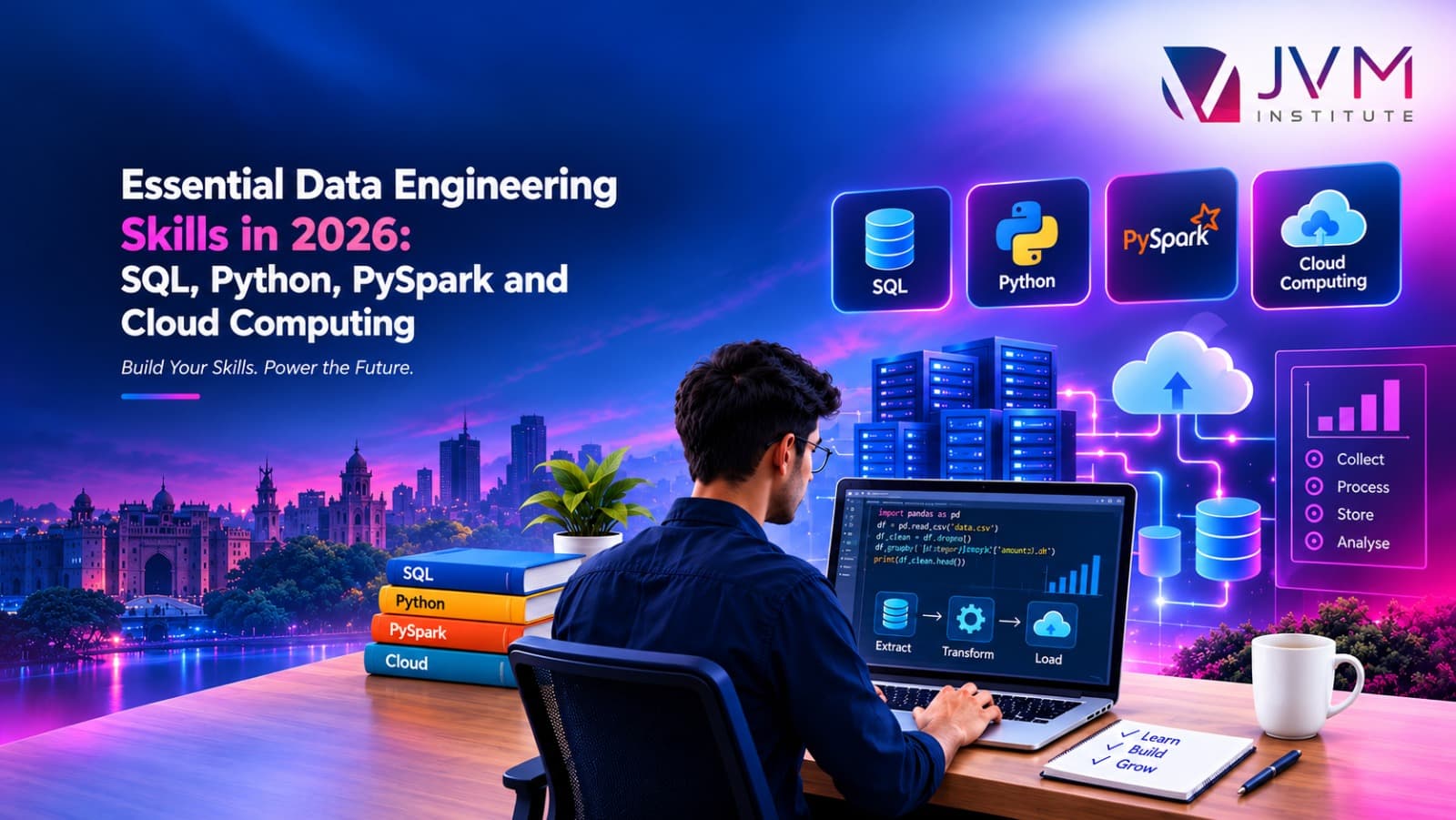
Essential Data Engineering Skills in 2026: SQL, Python, PySpark and Cloud Computing
Discover the technologies, practical skills and learning strategies that can help you prepare for a career in modern data engineering.
Introduction
Every digital interaction generates data. Online purchases, banking transactions, mobile applications, customer platforms and connected devices produce enormous volumes of information every day. However, raw data becomes valuable only when organisations can collect it, process it, organise it and make it available for analysis.
This is where data engineering comes in. Data engineers build and maintain the systems that move data from different sources into reliable, secure and scalable data platforms. Their work supports business intelligence, reporting, analytics and artificial intelligence applications.
In 2026, professionals who understand SQL, Python, PySpark and cloud computing have a strong foundation for working with modern data systems. If you are exploring Data Engineering courses in Pune, understanding these core skills can help you identify what to learn and how to practise it effectively.
What Is Data Engineering?
Data engineering is the process of designing, developing and maintaining infrastructure and workflows that make data usable. A data engineer collects information from databases, applications, APIs, files and other sources, transforms it into an appropriate format and delivers it to systems used for reporting, analytics or machine learning.
For example, an e-commerce company may collect order details, payment records, website activity and customer information. A data engineer builds pipelines to combine, clean and organise these datasets so that business teams can analyse sales performance, understand customer behaviour and monitor inventory.
What does a data engineer do?
- Builds data pipelines for collecting and transferring information.
- Writes SQL queries to extract and transform database records.
- Uses Python to automate tasks and process data.
- Processes large datasets with distributed computing frameworks such as Apache Spark.
- Deploys and manages data solutions on cloud platforms.
- Monitors data quality, performance, reliability and access controls.
- Collaborates with analysts, software developers, data scientists and business teams.
Why Are Data Engineering Skills Important in 2026?
Businesses increasingly rely on timely, accurate and accessible information. Data engineering provides the foundation needed to turn data into useful business insights. As cloud platforms, real-time processing and AI applications continue to evolve, organisations need professionals who can build dependable data infrastructure.
1. Growing data volumes
Applications and connected systems generate data continuously. Engineers help organisations manage, process and store this information efficiently.
2. Cloud-based infrastructure
Many organisations use cloud services to scale storage and computing resources according to their workloads and business requirements.
3. AI and machine learning
AI systems depend on accessible, well-structured and trustworthy data. Data engineers help prepare and deliver the datasets these systems require.
4. Business intelligence
Reliable data pipelines help teams produce consistent dashboards, reports and performance measurements for decision-making.
1. SQL: The Foundation of Data Engineering
SQL, or Structured Query Language, is one of the most important skills for anyone entering data engineering. It is used to retrieve, filter, combine and transform information stored in relational databases.
Data engineers use SQL to inspect source data, clean records, create analytical datasets and validate pipeline results. Strong SQL knowledge is particularly useful when working with data warehouses and cloud-based analytics platforms.
Important SQL concepts to learn
- Basic queries: SELECT, WHERE, ORDER BY and DISTINCT.
- Aggregations: COUNT, SUM, AVG, GROUP BY and HAVING.
- Joins: INNER JOIN, LEFT JOIN and other join types.
- Subqueries and CTEs: Organise complex query logic into manageable steps.
- Window functions: Calculate rankings, running totals and comparisons across rows.
- Database design: Understand primary keys, foreign keys, relationships and normalisation.
- Performance optimisation: Learn indexing concepts, query plans and efficient filtering.
Practical SQL example
Imagine an online store with an orders table containing customer IDs, order dates and order amounts. You can use SQL to calculate the total order value for each customer.
SELECT
    customer_id,
    SUM(order_amount) AS total_order_value
FROM orders
GROUP BY customer_id
ORDER BY total_order_value DESC;
This query groups orders by customer, calculates the total order value and displays customers from the highest to the lowest total. Similar queries help businesses understand purchasing patterns and measure performance.
2. Python: Automation and Data Processing
Python is a versatile programming language widely used for data processing, automation and integration. While SQL is ideal for querying structured data, Python helps engineers build reusable programs, connect different systems and automate repetitive workflows.
Python can be used to read CSV and JSON files, call APIs, validate incoming records, handle errors and orchestrate data-processing tasks. Libraries such as Pandas are useful for working with tabular datasets, while database connectors help applications interact with data stores.
Python skills every aspiring data engineer should develop
- Core programming: Variables, data types, loops, conditions and functions.
- Data structures: Lists, dictionaries, tuples and sets.
- File handling: Read and write CSV, JSON and text files.
- Error handling: Use exceptions, logging and validation to make scripts more reliable.
- Data libraries: Learn Pandas and understand when to use it for data manipulation.
- APIs: Retrieve information from external services and handle JSON responses.
- Database connectivity: Read from and write to databases using appropriate Python libraries.
- Testing and reusable code: Create modular functions and test important pipeline logic.
Practical Python example
The following example reads a CSV file and calculates the total order value using Pandas.
import pandas as pd

orders = pd.read_csv("orders.csv")

orders["order_amount"] = pd.to_numeric(
    orders["order_amount"],
    errors="coerce"
)

orders = orders.dropna(subset=["order_amount"])

summary = (
    orders.groupby("customer_id")["order_amount"]
    .sum()
    .reset_index(name="total_order_value")
)

print(summary.head())
This example illustrates a simple data-processing task. Real production pipelines may also require schema validation, secure credentials, monitoring, logging, retry logic and handling of large datasets.
3. PySpark: Processing Big Data at Scale
When datasets become too large or complex for efficient processing on a single machine, distributed computing can help. Apache Spark is a processing engine designed to work across multiple machines, and PySpark provides its Python interface.
PySpark allows engineers to apply familiar Python-based workflows to distributed data processing. It is commonly used for ETL and ELT pipelines, large-scale transformations, data preparation and batch analytics.
Key PySpark concepts
- Spark DataFrames: Work with structured, distributed datasets.
- Transformations: Filter, select, join, group and modify data.
- Actions: Trigger computation and return results or write output.
- Partitioning: Understand how data is distributed across processing tasks.
- Joins and aggregations: Combine and summarise large datasets efficiently.
- Performance tuning: Learn about shuffles, caching, execution plans and data skew.
- File formats: Work with formats such as Parquet and CSV.
Practical PySpark example
This example calculates total order value by customer using a Spark DataFrame.
from pyspark.sql import SparkSession
from pyspark.sql.functions import sum as spark_sum

spark = (
    SparkSession.builder
    .appName("OrderAnalysis")
    .getOrCreate()
)

orders = spark.read.option(
    "header", True
).option(
    "inferSchema", True
).csv("orders.csv")

summary = orders.groupBy("customer_id").agg(
    spark_sum("order_amount").alias("total_order_value")
)

summary.show()
For large production datasets, engineers should define and validate schemas, handle malformed records, review execution plans and select appropriate partitioning strategies. Distributed processing also introduces considerations such as network communication, shuffle costs and cluster resource management.
4. Cloud Computing: Building Scalable Data Platforms
Cloud computing allows organisations to access computing, storage, databases and managed data services without having to maintain all the underlying infrastructure themselves. Cloud knowledge helps data engineers build scalable and maintainable data solutions.
Common platforms include Amazon Web Services (AWS), Microsoft Azure and Google Cloud Platform (GCP). You do not need to master every platform at the beginning. Start with cloud fundamentals and develop practical experience with one platform before expanding your knowledge.
Cloud skills worth learning
- Cloud fundamentals: Regions, availability zones, identity, permissions and resource management.
- Object storage: Store files and datasets in services such as Amazon S3, Azure Data Lake Storage or Google Cloud Storage.
- Cloud data warehouses: Understand analytical platforms such as BigQuery, Amazon Redshift and Snowflake.
- Managed processing: Learn how cloud services run data transformations and distributed workloads.
- Security: Apply least-privilege access, encryption and appropriate secret management.
- Cost management: Monitor storage, processing and data-transfer expenses.
- Monitoring: Track failures, execution times, resource use and pipeline reliability.
How cloud computing supports a data pipeline
Consider a company that receives sales records every day. Files can be uploaded to cloud storage, validated using Python, transformed using SQL or Spark, and loaded into a cloud data warehouse for reporting.
This architecture makes it possible to separate storage, processing and analytics while allowing the organisation to scale individual components according to demand. The exact design depends on data volume, latency, security, reliability and cost requirements.
5. Additional Skills That Make Data Engineers More Effective
SQL, Python, PySpark and cloud computing form an important technical foundation, but professional data engineering involves much more than knowing four technologies.
ETL and ELT concepts
ETL stands for Extract, Transform and Load. Data is extracted from its sources, transformed and then loaded into a target system. ELT stands for Extract, Load and Transform, where data is loaded into the destination before transformations are performed there. Learn when each approach is appropriate.
Data modelling and warehousing
Understand fact tables, dimension tables, star schemas, data warehouse concepts and the difference between transactional and analytical systems. Good data modelling makes reporting easier to maintain and understand.
Workflow orchestration
Data pipelines often contain multiple tasks with dependencies. Tools such as Apache Airflow can schedule workflows, manage dependencies and help teams monitor task failures and reruns.
Version control and collaboration
Git helps engineers track changes, collaborate on code and review updates before deployment. Familiarity with branches, commits, pull requests and documentation is valuable in team environments.
Data quality and governance
Reliable pipelines need checks for missing fields, duplicate records, invalid values, unexpected schema changes and inconsistent data. Engineers should also understand data access policies, privacy requirements and retention rules.
6. How SQL, Python, PySpark and Cloud Work Together
These technologies are most useful when you understand how they fit into a complete data workflow rather than studying each one in isolation.
| Technology | Main purpose | Example application |
|---|---|---|
| SQL | Querying and transforming structured data | Extracting sales information and preparing reports |
| Python | Automation, integration and data processing | Fetching API data and validating files |
| PySpark | Distributed processing of large datasets | Transforming millions of transaction records |
| Cloud computing | Scalable infrastructure and managed services | Storing, processing and analysing data in the cloud |
| Orchestration | Scheduling and coordinating tasks | Running daily ingestion and transformation workflows |
7. A Practical 12-Week Data Engineering Learning Roadmap
A structured learning plan can help beginners build knowledge progressively. The time required depends on your existing programming skills, available study hours and project experience.
Weeks 1–3: SQL and databases
- Learn SQL syntax, joins, aggregations and subqueries.
- Practise window functions and common table expressions.
- Build a small database for orders, customers and products.
Weeks 4–5: Python fundamentals
- Practise functions, data structures, file handling and exceptions.
- Read CSV and JSON files and connect to an API.
- Create a script that validates and cleans incoming records.
Weeks 6–7: ETL and data modelling
- Combine data from multiple sources.
- Learn ETL and ELT patterns and basic data warehouse design.
- Store clean, structured output for analysis.
Weeks 8–9: PySpark and distributed data
- Practise DataFrame operations, joins and aggregations.
- Read and write Parquet files.
- Explore partitioning and basic performance considerations.
Weeks 10–11: Cloud fundamentals
- Choose AWS, Azure or GCP to begin with.
- Practise cloud storage and permissions in a controlled environment.
- Explore a managed data service and monitor resource costs.
Week 12: Build and document a project
- Combine SQL, Python, PySpark and cloud services where appropriate.
- Add data-quality checks and error handling.
- Document your architecture, setup and results in a Git repository.
This roadmap is a suggested starting point, not a guarantee of job readiness. Continue practising, improving your projects and learning from real-world data engineering scenarios.
8. Project Ideas for Building Practical Experience
Projects help you demonstrate how you apply technical concepts. Start with a small dataset and gradually introduce more complex tools and workflows.
Project 1: Sales data pipeline
Import sample sales data from CSV files, clean records with Python, load them into a database and use SQL to calculate revenue by product, region and month. Add validation checks for missing customer IDs and invalid order amounts.
Project 2: API data ingestion
Use a public API to retrieve structured information, convert the response into a consistent format and store it for analysis. Include error handling, logging and a process for handling API failures.
Project 3: Large-scale transaction processing
Use PySpark to process a larger synthetic transaction dataset. Practise grouping, filtering, joining and writing results in Parquet format. Compare the workflow with a smaller Pandas-based solution.
Project 4: Cloud-based analytics workflow
Store datasets in a cloud storage service, process them using suitable tools and make the resulting data available for analytics. Configure appropriate permissions, document the architecture and monitor costs.
Project 5: Automated data workflow
Create a scheduled pipeline that ingests data, runs transformations, validates output and records execution status. An orchestration tool can help coordinate tasks and support retries when a step fails.
9. Career Opportunities After Learning Data Engineering
Data engineering knowledge can support several career paths, depending on your experience and the technologies you develop.
- Junior Data Engineer: Assists with data ingestion, transformation, testing and pipeline maintenance.
- Data Engineer: Builds and manages reliable data pipelines and storage systems.
- Cloud Data Engineer: Develops data platforms using cloud infrastructure and managed services.
- Big Data Engineer: Works with distributed processing technologies and large-scale datasets.
- Analytics Engineer: Organises and transforms data for reporting, metrics and business analysis.
- Data Platform Engineer: Helps maintain the shared infrastructure, tooling and reliability of data platforms.
Job titles and responsibilities vary by organisation. Career progression depends on practical skills, relevant experience, problem-solving ability, communication and the requirements of individual employers.
10. How to Choose Data Engineering Courses in Pune
If you want to learn these skills through structured instruction, selecting the right course is an important step. Compare the curriculum, practical sessions, instructor experience and project opportunities before enrolling.
When comparing best Data Engineering courses in Pune, look beyond the course title. A useful programme should explain how the technologies work together and provide opportunities to apply them to realistic problems.
What should a good course include?
- SQL fundamentals, advanced queries and database concepts.
- Python programming, file processing and automation.
- Apache Spark and PySpark practical exercises.
- Cloud fundamentals and hands-on work with a selected cloud platform.
- ETL and ELT workflows, data modelling and data warehousing.
- Project-based learning, debugging and data-quality validation.
- Guidance on Git, documentation and interview preparation.
Data Engineering classes in Pune
When evaluating Data Engineering classes in Pune, consider whether the learning format suits your schedule and current knowledge. Ask about practical lab access, project reviews, class size, support after sessions and the expected level of prior programming experience.
Best Data Engineering classes in Pune: What to compare
The best Data Engineering classes in Pune for you will depend on your goals. Beginners may benefit from a course that starts with SQL and Python, while experienced developers may prefer more advanced training in Spark, cloud architecture and pipeline optimisation.
Review the course syllabus and ask how much time is allocated to hands-on work. Confirm what tools you will use and whether you will complete projects that can be discussed during interviews.
Data Engineering training in Pune
Practical Data Engineering training in Pune can help learners connect theoretical knowledge with implementation. Look for exercises that involve importing data, writing transformations, handling errors and producing reliable outputs instead of relying exclusively on demonstrations.
Cloud Computing Classes in Pune
Cloud Computing Classes in Pune can complement data engineering training by introducing cloud storage, access management, computing services, monitoring and cost controls. Choose a programme that relates cloud concepts to data pipelines and analytical workloads.
Questions to ask before enrolling
- Does the syllabus cover SQL, Python, PySpark and cloud computing?
- Will I build complete data engineering projects?
- Are practical labs and doubt-clearing sessions included?
- Which cloud platform and data tools will I use?
- What level of prior programming knowledge is expected?
- What career guidance or interview preparation is provided?
11. Common Mistakes Beginners Should Avoid
- Learning tools without understanding fundamentals: Build a strong foundation in databases, programming and data modelling.
- Skipping SQL practice: Practise queries regularly because data retrieval and transformation are common engineering tasks.
- Using only sample code: Modify projects, troubleshoot errors and explain why your approach works.
- Ignoring data quality: Learn to detect missing values, duplicates, invalid formats and unexpected changes.
- Overlooking cloud costs and security: Use controlled environments, suitable permissions and budget alerts when available.
- Building projects without documentation: Describe the architecture, setup, assumptions and limitations of your solution.
- Trying to learn every platform at once: Master core concepts and one cloud platform before broadening your toolkit.
Frequently Asked Questions
1. Which skills are essential for data engineering in 2026?
SQL, Python, data modelling, ETL and ELT concepts, distributed processing with tools such as PySpark, and cloud computing are important foundations. Version control, orchestration, data quality and security are also valuable.
2. Can a beginner learn data engineering?
Yes. Beginners can start with SQL and basic programming, then progress to Python, databases, data pipelines, Spark and cloud platforms. Consistent practice and project work are important.
3. Should I learn Python or SQL first?
SQL is a useful starting point because it introduces structured data and querying. You can learn Python alongside it or immediately afterward. The best sequence depends on your previous experience and learning goals.
4. Why is PySpark useful for data engineers?
PySpark provides a Python interface for Apache Spark, enabling distributed processing across a cluster. It is useful for many large-scale data transformation and analytics workloads.
5. Is cloud computing necessary for data engineering?
Cloud computing is highly relevant to many modern data engineering roles, although some organisations also operate on-premises or hybrid systems. Understanding storage, compute, security and managed data services is beneficial.
6. How long does it take to learn data engineering?
The learning timeline depends on your programming background, study time and the depth of knowledge you want to develop. A 12-week plan can establish a foundation, but becoming job-ready generally requires continued practice and project experience.
7. How can I compare Data Engineering courses in Pune?
Compare the syllabus, practical labs, trainer experience, project work, cloud platform coverage, learning support and career guidance. Choose a programme that matches your current level and goals.
8. Are Cloud Computing Classes in Pune useful for aspiring data engineers?
Yes. Cloud training can help you understand scalable storage, compute resources, access controls and managed services used to build and operate data pipelines.
Conclusion: Build Your Data Engineering Skills Step by Step
Data engineering brings together programming, databases, data processing and infrastructure. SQL helps you query and transform structured information, Python supports automation and integration, PySpark enables distributed processing, and cloud computing provides scalable infrastructure for modern data workflows.
To develop these skills, focus on fundamentals, practise consistently and build projects that solve practical problems. Add data quality, orchestration, version control and security to your learning plan as you progress.
If you are exploring Data Engineering courses in Pune, best Data Engineering courses in Pune or Data Engineering training in Pune, compare programmes carefully and choose one that offers a balanced combination of theory, hands-on learning and project experience.
Ready to Start Your Data Engineering Journey?
Explore structured learning, practical projects and the technologies used in modern data engineering. Choose a learning path that matches your experience and career goals.
Explore Data Engineering Course in PuneDiscover essential data engineering skills in 2026, including SQL, Python, PySpark and cloud computing, and explore Data Engineering courses in Pune.
Explore technical architecture details and live engineering code examples.

JVM Technical Team
Published by senior IT faculty members and industry lead architects at JVM Institute Pune. Dedicated to empowering students with real-world Data Engineering, AI/ML, PySpark, and Cloud computing expertise.