Quick Section Index
- 1.What Is Generative AI?
- 2.How Does Generative AI Work?
- 3.Popular Applications of Generative AI
- 4.Important Generative AI Tools to Know
- 5.Career Opportunities in Generative AI
- 6.Skills to Learn for Generative AI in 2026
- 7.How to Start Learning Generative AI
- 8.Learn AI and Machine Learning at JVM Institute, Pune
- 9.Frequently Asked Questions (FAQs)
- 10.Start Your AI Learning Journey
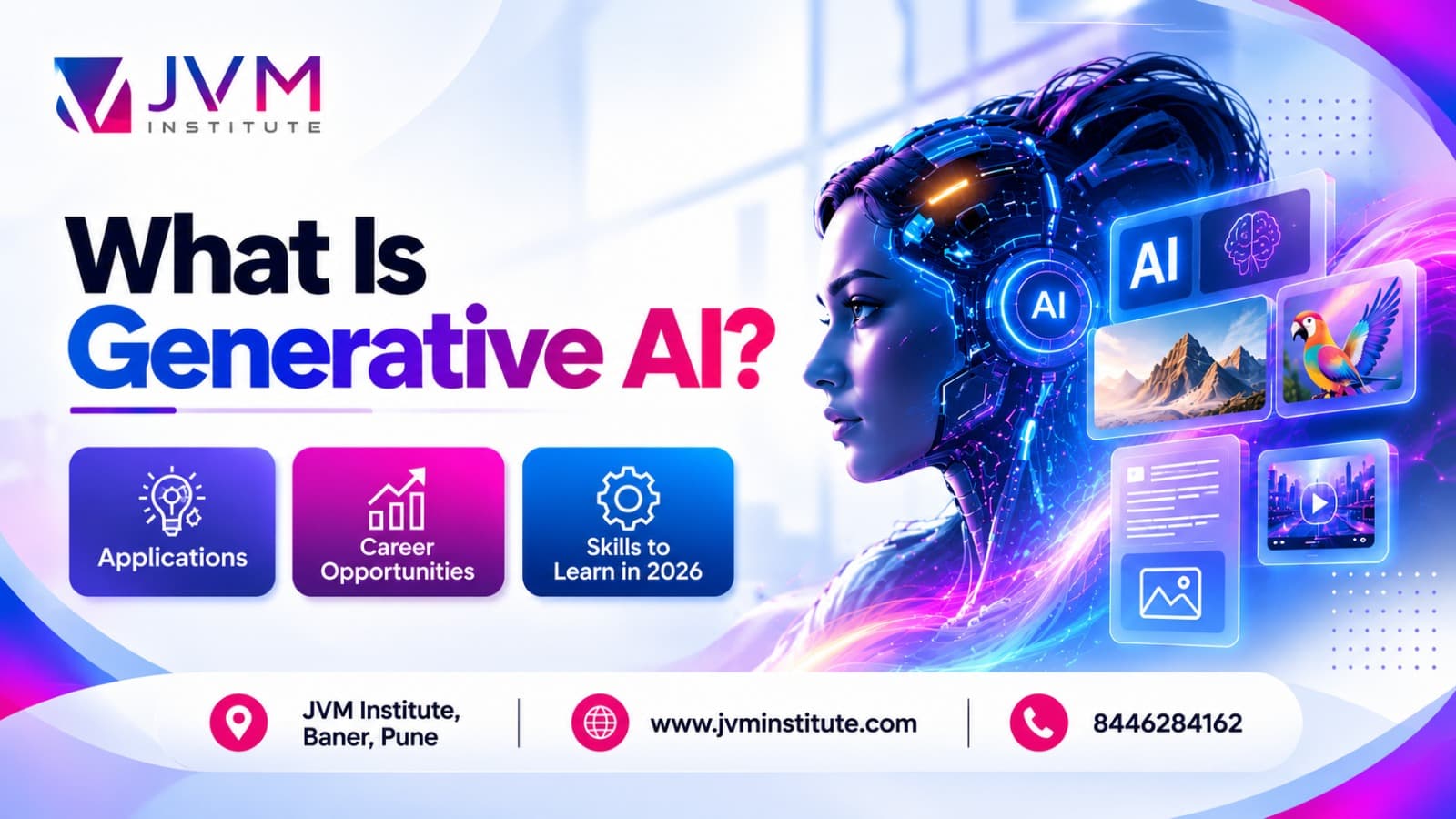
What Is Generative AI? Applications, Career Opportunities and Skills to Learn in 2026
Generative Artificial Intelligence (Generative AI) is transforming how businesses create content, analyse information, develop software, and solve problems. From AI-powered chatbots and image generation to intelligent business automation, this technology is creating new opportunities across industries.
For students, freshers, and working professionals, understanding Generative AI can be a valuable step towards building future-ready technology skills.
What Is Generative AI?
Generative AI is a branch of artificial intelligence that creates new content based on patterns learned from training data. It can generate text, images, computer code, audio, video, summaries, and other forms of digital content.
Traditional AI systems often focus on identifying patterns, making predictions, or classifying information. Generative AI goes further by producing new outputs in response to user instructions, questions, or prompts.
How Does Generative AI Work?
Generative AI models learn patterns and relationships from large datasets during training. When a user provides a prompt, the model uses those learned patterns to generate a relevant response.
Key Stages of Generative AI
- Data collection: Relevant data is collected and prepared for training.
- Model training: The model learns patterns and relationships within the data.
- Prompt input: A user provides instructions or a question.
- Content generation: The model produces an output based on the prompt and its learned patterns.
- Review and refinement: The output is checked for accuracy, relevance, and quality.
Generative AI can sometimes produce incorrect or misleading information. Human review is therefore important, especially when working with technical, financial, legal, or other sensitive information.
Popular Applications of Generative AI
1. Content Creation and Digital Marketing
Generative AI can assist with blog outlines, social media captions, email drafts, advertising ideas, product descriptions, and content planning. Marketers can use these tools to speed up initial drafting while maintaining human review and brand consistency.
2. Chatbots and Customer Support
AI-powered assistants can answer common questions, summarise support requests, help users find information, and support customer service teams. Businesses can integrate these systems into websites and other digital platforms.
3. Software Development
Generative AI tools can help developers explain code, generate examples, identify possible errors, create documentation, and explore solutions to programming problems. Developers still need to test and verify the results.
4. Education and Training
AI tools can explain difficult concepts, create practice questions, summarise study material, and support personalised learning. Educators and learners should verify important facts and use these tools responsibly.
5. Data Analysis and Business Operations
Generative AI can assist with summarising reports, exploring datasets, preparing business documents, and explaining analytical findings. Its usefulness depends on data quality, tool capabilities, and appropriate human oversight.
6. Image, Audio, and Video Generation
Generative models can create or transform visual and audio content. These capabilities are used in design, advertising, entertainment, training materials, and creative production.
Important Generative AI Tools to Know
- ChatGPT: Assists with writing, research, brainstorming, and problem-solving.
- Google Gemini: Supports conversational AI and a range of productivity tasks.
- Microsoft Copilot: Helps with supported productivity and work-related tasks.
- GitHub Copilot: Assists developers with code suggestions and programming workflows.
- Hugging Face: Provides access to machine learning models, datasets, and development resources.
Different tools offer different capabilities. Learners should choose tools according to their goals, available features, privacy requirements, and budget.
Career Opportunities in Generative AI
As organisations explore AI adoption, professionals with relevant technical, analytical, and practical skills may find opportunities in several roles. The required qualifications and experience vary by employer.
- Generative AI Engineer: Builds and integrates applications powered by generative models.
- Machine Learning Engineer: Develops, evaluates, and deploys machine learning systems.
- AI Application Developer: Creates applications using AI models and APIs.
- Data Scientist: Uses data analysis, statistics, and machine learning to solve business problems.
- AI Researcher: Studies AI methods, models, and potential improvements.
- AI Automation Specialist: Uses AI tools to improve workflows and automate suitable tasks.
- AI Content Specialist: Uses AI-assisted workflows for content development and communication.
Skills to Learn for Generative AI in 2026
1. Python Programming
Python is widely used in machine learning and AI development. Learn variables, functions, data structures, libraries, file handling, and basic programming logic.
2. Artificial Intelligence and Machine Learning Fundamentals
Understand key concepts such as supervised learning, unsupervised learning, neural networks, model training, and model evaluation.
3. Prompt Engineering
Learn how to write clear instructions, provide useful context, define output formats, and evaluate AI-generated responses. Effective prompting also includes checking the output rather than assuming it is correct.
4. Large Language Models and Generative AI Concepts
Explore how large language models work, their capabilities and limitations, and concepts such as tokens, embeddings, context windows, and model inference.
5. Data Handling and Evaluation
Learn how to organise data, assess its quality, evaluate model outputs, and identify potential errors, bias, and privacy risks.
6. APIs and AI Application Development
For development-focused roles, learn how APIs connect applications to AI services. Build small projects that use AI to solve a clearly defined problem.
How to Start Learning Generative AI
- Understand the basics: Learn what AI, machine learning, and Generative AI mean.
- Explore AI tools: Practise writing prompts and evaluating the results.
- Learn Python: Build a foundation if your goal is technical AI development.
- Study machine learning: Understand models, data, training, and evaluation.
- Build practical projects: Create a chatbot prototype, document summariser, or AI-assisted workflow.
- Create a portfolio: Document your projects, explain your approach, and show what you learned.
Learn AI and Machine Learning at JVM Institute, Pune
Learners who want to build a foundation in Artificial Intelligence and Machine Learning can explore the training options available at JVM Institute, Pune. Before enrolling, review the current syllabus, practical project work, trainer support, and course details to ensure they match your learning goals.
Explore the AI and Machine Learning course in Pune to learn more about the available course information.
You can also visit the official JVM Institute website for additional information about training programmes.
Frequently Asked Questions (FAQs)
1. What is Generative AI in simple words?
Generative AI is a type of artificial intelligence that can create new content, such as text, images, code, audio, and other outputs, based on instructions and patterns learned from data.
2. Do I need coding skills to learn Generative AI?
Not always. Beginners can start by learning to use AI tools and write effective prompts. However, Python and programming knowledge are important for many AI engineering and machine learning development roles.
3. Which programming language is useful for AI?
Python is a popular choice because it has a large ecosystem of libraries and frameworks for data analysis, machine learning, and AI application development.
4. What projects can beginners build?
Beginners can start with an FAQ chatbot, a document summariser, an AI-assisted content workflow, or a simple application that uses a generative AI API.
5. Is Generative AI useful for digital marketing?
Yes. It can assist with content ideas, campaign drafts, audience research summaries, and creative brainstorming. Marketers should review generated content for accuracy, originality, brand voice, and platform requirements.
6. Where can I learn AI and Machine Learning in Pune?
You can explore the course information available from JVM Institute, Pune and check whether its current curriculum aligns with your learning objectives.
Start Your AI Learning Journey
Build your understanding of AI and Machine Learning, explore practical applications, and work towards developing future-ready skills.
Explore the AI & ML CourseExplore Generative AI applications, career opportunities, essential skills, and how to start your AI journey with Data Engineering and Cloud Computing training in Pune.
Explore technical architecture details and live engineering code examples.

JVM Technical Team
Published by senior IT faculty members and industry lead architects at JVM Institute Pune. Dedicated to empowering students with real-world Data Engineering, AI/ML, PySpark, and Cloud computing expertise.