Quick Section Index
- 1.Introduction: The Big Data & Artificial Intelligence Era
- 2.What is Data Engineering? (Deep Architectural Breakdown)
- 3.What is Data Science & Machine Learning?
- 4.Detailed Side-by-Side Comparison Matrix
- 5.2026 Salary Packages in India (Pune, Bengaluru, Hyderabad, NCR)
- 6.Start Your Data Engineering Career with JVM Institute
Introduction: The Big Data & Artificial Intelligence Era
Data has become the fundamental operational asset driving modern global enterprises. From financial institutions processing real-time credit card transactions to e-commerce platforms personalizing buyer recommendations and healthcare organizations training diagnostic Artificial Intelligence (AI) models, decision-making is completely data-driven.
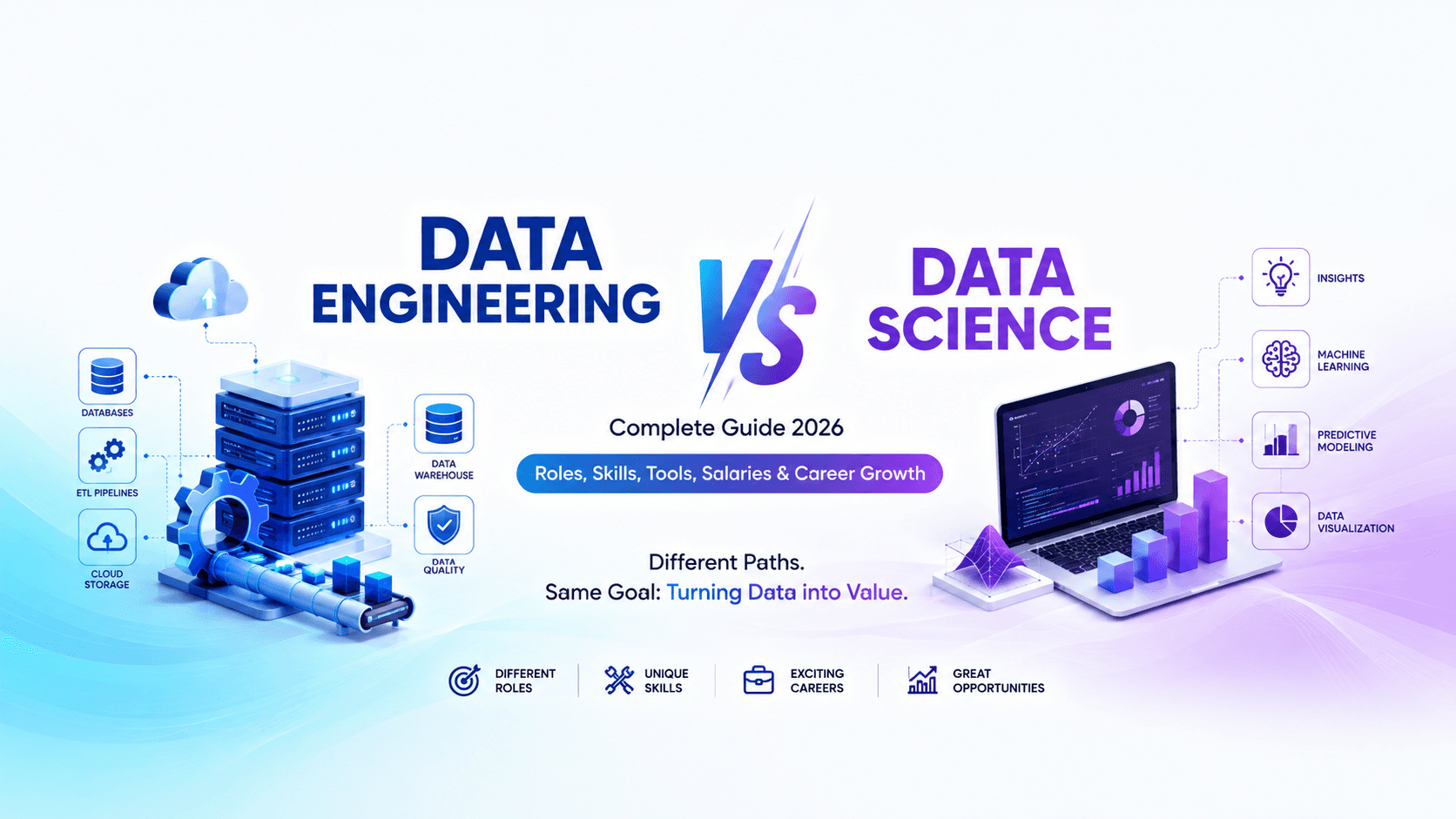
Two of the most lucrative, high-impact career tracks in the technology industry today are Data Engineering and Data Science. While both fields revolve around analyzing, transforming, and utilizing data, their daily operational responsibilities, technical toolstacks, architectural priorities, and required mathematical proficiencies differ substantially.
Many students, computer science graduates, and working IT professionals frequently ask: "Should I learn Data Engineering or Data Science in 2026? Which domain offers better long-term salary growth, career stability, job volume, and growth into cloud architecture?"
This comprehensive 2026 guide provides an in-depth analysis of Data Engineering vs Data Science—covering role definitions, architectural comparisons, technical toolstacks, updated salary ranges across India (Pune, Bengaluru, Hyderabad, NCR), learning curves, step-by-step career roadmaps, and guidance on selecting the right path for your technical background.
What is Data Engineering? (Deep Architectural Breakdown)
Data Engineering is the core software engineering discipline focused on designing, constructing, testing, orchestrating, and maintaining the scalable data infrastructure, pipelines, and platforms required to collect, clean, transform, and deliver data at scale.
Without Data Engineers, enterprise data remains trapped in transactional SQL databases, fragmented legacy ERPs, or unorganized third-party APIs. Raw data is inherently messy—full of duplicate entries, missing schema fields, timestamp mismatches, and structural noise. Data Engineers act as digital architects who build automated highways ensuring clean, reliable, sub-second data flows into analytics platforms and AI algorithms.
Core Operational Responsibilities of a Data Engineer:
- Building Production Data Pipelines (ETL/ELT): Authoring robust Extract, Transform, Load (ETL) and Extract, Load, Transform (ELT) workflows that automate data ingestion from relational databases, Web APIs, IoT sensors, and cloud object stores using tools like Apache Airflow, AWS Glue, and Azure Data Factory.
- Distributed Big Data Processing: Processing petabyte-scale datasets across distributed clusters using in-memory computing engines like Apache Spark (PySpark) and distributed storage solutions.
- Architecting Cloud Data Warehouses & Lakehouses: Designing high-performance storage schemas in modern cloud warehouses (Snowflake, Google BigQuery, Amazon Redshift) and open table formats (Delta Lake, Apache Iceberg).
- Event Streaming & Message Queues: Implementing real-time event-driven data streaming pipelines using Apache Kafka, RabbitMQ, or AWS Kinesis to handle continuous telemetry.
- Data Governance, Quality & Security: Enforcing strict encryption standards, role-based access controls (RBAC), schema validations, data lineage tracking, and compliance (GDPR/HIPAA).
- Database Performance Tuning: Structuring relational tables (PostgreSQL, MySQL), indexing partition keys, creating materialized views, and optimizing NoSQL document databases (MongoDB, Cassandra).
What is Data Science & Machine Learning?
Data Science is an advanced analytical discipline combining mathematical modeling, statistics, computer programming, and business domain expertise to extract commercial insights, discover non-obvious patterns, build predictive machine learning models, and drive strategic decision-making.
While Data Engineers focus on building the infrastructure to deliver data, Data Scientists consume that clean data to perform exploratory data analysis (EDA), test statistical hypotheses, train predictive algorithms, and build intelligent machine learning features for products.
Core Operational Responsibilities of a Data Scientist:
- Exploratory Data Analysis (EDA): Applying statistical methods to understand data distributions, correlations, outliers, and feature significance.
- Predictive Machine Learning Modeling: Building, training, tuning, and evaluating ML algorithms (Regression, Logistic Classification, Decision Trees, Random Forests, XGBoost, LightGBM).
- Deep Learning & Artificial Intelligence: Developing neural network architectures using PyTorch or TensorFlow for Natural Language Processing (NLP), Computer Vision, and Generative AI (LLM fine-tuning).
- Statistical Hypothesis Testing & Experimentation: Designing and analyzing A/B tests, calculating confidence intervals, and validating product feature changes statistically.
- Executive Visual Storytelling: Crafting strategic dashboards in Tableau, Power BI, or Streamlit to present mathematical findings to C-suite executives and business stakeholders.
Detailed Side-by-Side Comparison Matrix
| Category | Data Engineering | Data Science |
|---|---|---|
| Primary Goal | Construct & maintain scalable data infrastructure & pipelines | Analyze patterns, test hypotheses & build predictive ML models |
| Core Focus | System architecture, ETL/ELT, scalability, data quality, cloud | Applied statistics, machine learning, deep learning, business insights |
| Primary Languages | Python, SQL, PySpark, Java, Scala | Python, R, SQL, Julia |
| Main Toolstack | Apache Spark, Airflow, Snowflake, Kafka, AWS Glue, dbt, Docker | Pandas, NumPy, Scikit-Learn, TensorFlow, PyTorch, Jupyter, Tableau |
| Mathematical Depth | Moderate (Boolean algebra, discrete logic, hash structures) | Advanced (Multivariable Calculus, Linear Algebra, Probability) |
2026 Salary Packages in India (Pune, Bengaluru, Hyderabad, NCR)
Data Engineer Salary Ranges (India 2026)
- Fresher (0–1 Yrs): ₹4.8 LPA – ₹8.5 LPA
- Junior Engineer (1–3 Yrs): ₹8.5 LPA – ₹14.0 LPA
- Mid-Level (3–6 Yrs): ₹14.0 LPA – ₹24.0 LPA
- Senior Data Engineer (6–9 Yrs): ₹24.0 LPA – ₹40.0 LPA+
- Lead / Cloud Architect (10+ Yrs): ₹40.0 LPA – ₹70.0 LPA+
Data Scientist Salary Ranges (India 2026)
- Fresher (0–1 Yrs): ₹5.0 LPA – ₹9.5 LPA
- Junior Scientist (1–3 Yrs): ₹9.5 LPA – ₹15.0 LPA
- Mid-Level (3–6 Yrs): ₹15.0 LPA – ₹26.0 LPA
- Senior Scientist (6–9 Yrs): ₹26.0 LPA – ₹45.0 LPA+
- AI Research Principal (10+ Yrs): ₹45.0 LPA – ₹75.0 LPA+
Start Your Data Engineering Career with JVM Institute
JVM Institute Pune offers a 24-Week Data Engineering Master Track with 100% Placement Assistance, live production PySpark clusters, Snowflake warehouses, AWS Glue pipelines, and 1-on-1 mentorship from senior data architects.

JVM Technical Team
Published by senior IT faculty members and industry lead architects at JVM Institute Pune. Dedicated to empowering students with real-world Data Engineering, AI/ML, PySpark, and Cloud computing expertise.