Quick Section Index
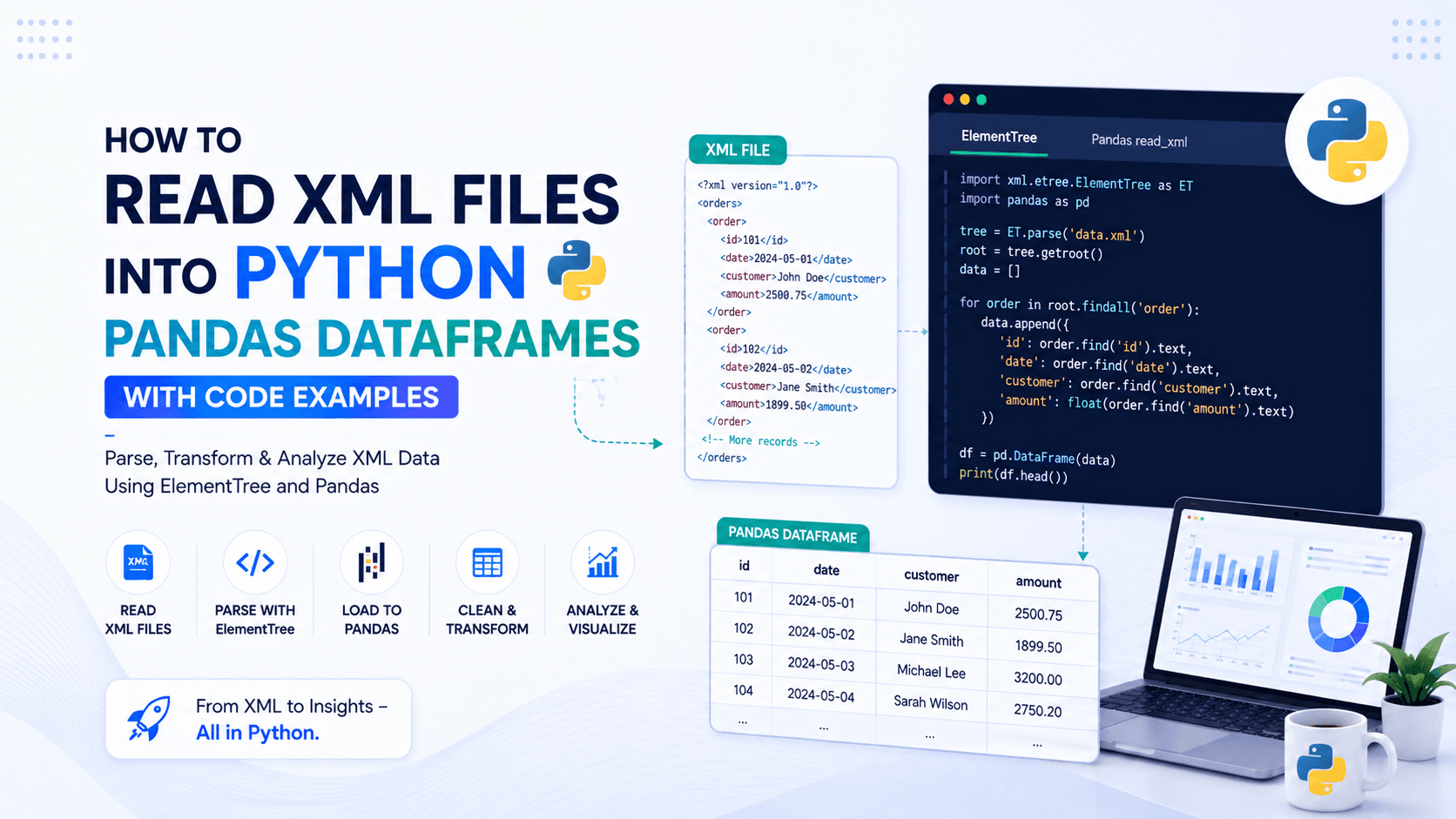
How to Read XML Files into Python Pandas DataFrames (With Code)
In enterprise data engineering pipelines—especially within banking, financial services, healthcare, and legacy ERP systems—data is frequently delivered in XML (Extensible Markup Language) format.
Unlike flat CSV or JSON files, XML files contain nested hierarchies, namespaces, and node attributes that require specific parsing techniques. In this hands-on tutorial, we explore how to parse XML files into clean Pandas DataFrames using Python.
Method 1: Using Pandas pd.read_xml() (Fastest & Easiest)
Since Pandas version 1.3+, the built-in pd.read_xml() function parses flat XML structures directly into a DataFrame with a single line of code:
import pandas as pd

# Reading flat XML file into Pandas DataFrame
df = pd.read_xml("data.xml")

# Displaying first 5 rows
print(df.head())
Method 2: Using xml.etree.ElementTree for Complex Nested XML
For deeply nested XML schemas containing custom attributes, use Python's native xml.etree.ElementTree module to extract specific nodes:
import xml.etree.ElementTree as ET
import pandas as pd

# Parse XML file
tree = ET.parse('data.xml')
root = tree.getroot()

data = []
for item in root.findall('Record'):
    row = {
        'id': item.find('ID').text,
        'name': item.find('Name').text,
        'value': item.find('Value').text
    }
    data.append(row)

# Convert list of dictionaries to DataFrame
df = pd.DataFrame(data)
print(df.head())
Master Real-World Data Engineering at JVM Institute
Learn how to parse, transform, and load complex XML, JSON, and Parquet data into cloud warehouses at JVM Institute Pune.
Every single day, over 328 million terabytes of raw data are created across global digital networks. Yet without structured processing systems, 90% of enterprise data remains unstructured, isolated, and unusable.
Data engineering is the indispensable discipline that transforms chaotic, raw data streams into clean, reliable, and actionable business intelligence.
1. The Evolution of Data Engineering
Data engineering has undergone a monumental shift. In the early 2000s, traditional relational databases and monolith data warehouses handled nightly batch jobs. As data volume exploded, technologies like Apache Hadoop introduced distributed computing via HDFS and MapReduce.
Today, modern cloud data platforms like Databricks, Snowflake, and AWS Glue enable real-time streaming, serverless ETL pipelines, and unified Lakehouse analytics, making data engineering indispensable across finance, healthcare, e-commerce, and logistics.
2. The Skills of a Data Engineer
To excel as a data engineer, mastering a core set of technical competencies is essential: proficiency in programming languages (Python, PySpark, SQL), data modeling (Star & Snowflake schemas), automated ETL/ELT orchestration, and cloud infrastructure.
At JVM Institute, our hands-on training programs empower students to master these skills with live Databricks clusters and production Airflow DAGs. Over 200+ JVM alumni have successfully transitioned into high-paying engineering roles across Tier-1 tech MNCs.
Pro Tip: Combining Python XML element trees with PySpark DataFrames provides high performance when ingesting legacy enterprise files.
import xml.etree.ElementTree as ET
import pandas as pd

# Parsing XML Data Files into Python DataFrames
tree = ET.parse("data_pipeline_export.xml")
root = tree.getroot()

records = []
for item in root.findall(".//record"):
    records.append({
        "id": item.find("id").text,
        "event": item.find("event").text,
        "value": float(item.find("value").text)
    })

df = pd.DataFrame(records)
print("Parsed Data Summary:\n", df.head())
3. Real-World Applications across Industries
Data engineering powers real-world innovations across every sector: in finance, stream processing detects fraudulent transactions in milliseconds; in healthcare, pipelines aggregate patient IoT telemetry; in e-commerce, automated pipelines fuel hyper-personalized recommendation engines.
Students at JVM Institute complete real-world capstone projects—such as building 100GB live streaming pipelines—demonstrating complete readiness for enterprise challenges.
4. The Impact of Data Engineering
The impact of data engineering extends far beyond code—it is the foundation of AI, machine learning models, and executive decision-making. As enterprises migrate to cloud-native data platforms, demand for skilled Data Engineers continues to outpace supply, offering extraordinary career growth and compensation.
Conclusion: Embark on Your Data Journey
Data engineering is the driving force behind modern business transformation. By mastering data manipulation, cloud warehouses, and pipeline orchestration, you unlock endless career opportunities.
Take the first step in your data engineering journey today! Explore JVM Institute’s industry-accredited training programs and register for our upcoming live batches.
Explore JVM Institute's 6-Month Data Engineering Master Track in Pune with 100% Placement Assistance.

JVM Technical Team
Published by senior IT faculty members and industry lead architects at JVM Institute Pune. Dedicated to empowering students with real-world Data Engineering, AI/ML, PySpark, and Cloud computing expertise.